
Fleet Dispatch Software for Carriers
The Fleetika Carrier subscription is built for businesses whose work is moving vehicles on demand. A request comes in — a ride, a tow, a haul, a machine needed in a field — and you assign the right vehicle, see where it is, and confirm the job is done. That's the order logic this plan runs on: the same on-demand dispatch behind ride-hailing apps, applied to whatever your fleet does. You can also build simple multi-stop routes and take orders straight from your own website or a branded app. It starts at $120/mo as a package priced by fleet size.
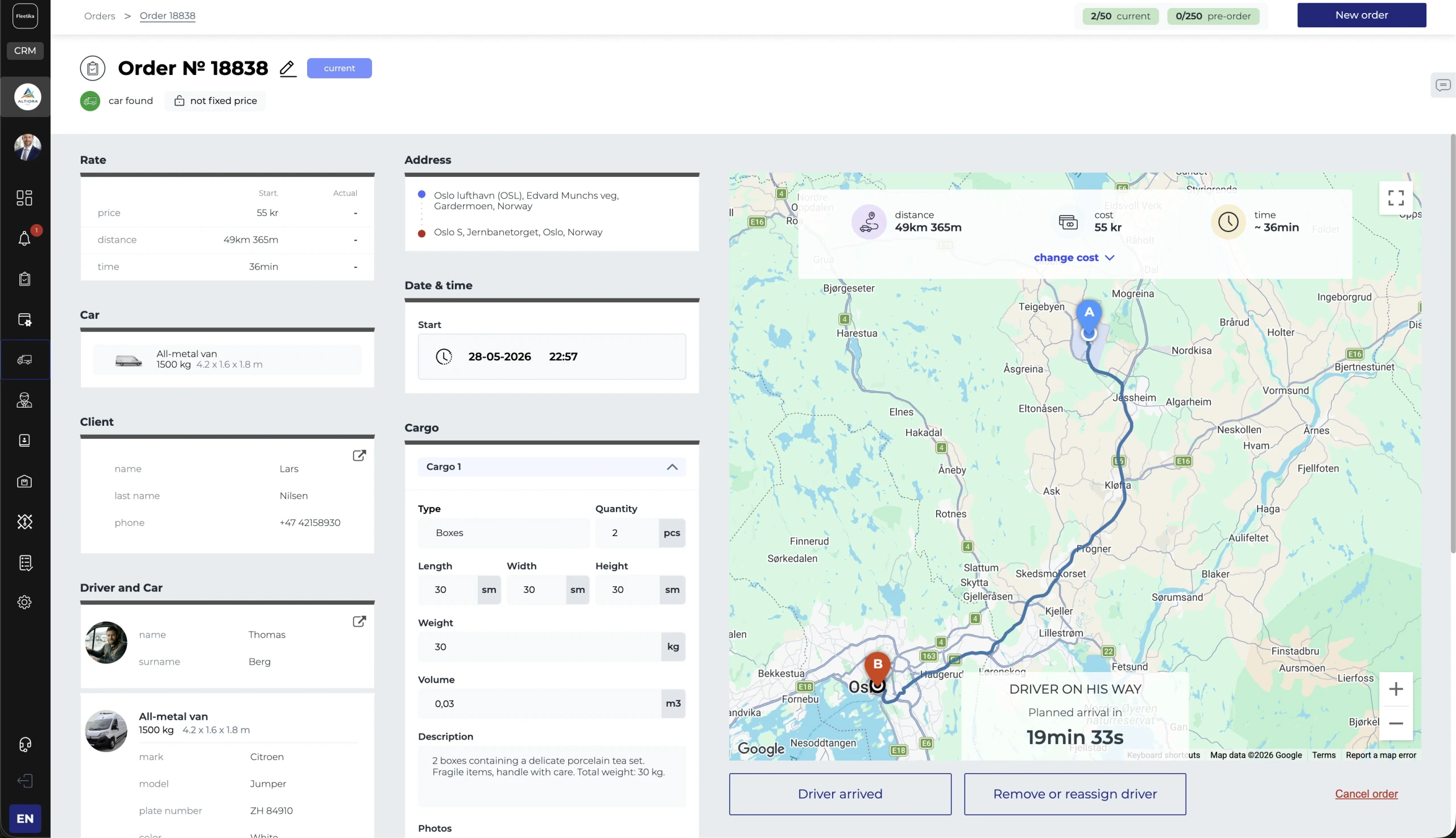
On-demand dispatch — the carrier's order logic
At the core of a carrier operation is on-demand dispatch: a request arrives, you assign the nearest or best-suited vehicle, track it live from assignment to completion, and close the job with proof. It's the logic you already know from ride-hailing — a customer requests, the right vehicle is matched, the trip is tracked, the job ends. You get that backbone for your own fleet.
It isn't limited to a single point-to-point trip. You can add several stops to a route — up to around two dozen — list the goods for each, and have the sequence built for you. What the Carrier plan keeps light is the heavy optimization: it doesn't weigh delivery time windows or vehicle load capacity, and it leaves out the advanced constraints made for high-volume distribution. Those live in the Distributor plan. If your work is on-demand jobs and simple routes rather than dense, constraint-heavy delivery runs, Carrier is the fit.
What you can run on it
A few of the operations the Carrier plan is built for:
What you get with the Carrier plan
Whatever you move, you work from one system:
- You see every vehicle live, on one map, with time-stamped history.
- You dispatch in seconds from the dispatcher portal, and the job lands on the driver's phone in the F-Driver app.
- You confirm each job with proof — photo, signature and geolocation captured on the spot (digital ePOD).
- Arrivals are tied to location with geofencing, so "arrived" means actually there.
- You catch delays early with proactive ETA alerts, not after a customer calls.
- Your managers see the whole operation in the F-Manager app — and can summon a vehicle from the fleet themselves. Your team communicates through the built-in contact centre and chats.
- You keep the hardware you own — Wialon, Teltonika, Sinotrack and GT06 connect natively, and a tracker on a different GPS protocol can be added as a separate integration.
- FMS and TMS are included, so fleet management and transport orders live in the same platform.
Your own order intake and branded app
Two things make the Carrier plan more than a back office. You can drop an order widget onto your website, so customers place requests that land straight in your dispatch queue — no phone tag, no retyping. And you can put your service in front of customers under your own brand, with a branded app instead of a generic one. For a ride service, a tow company or an on-demand hauler, that's the difference between running on someone else's platform and owning the customer relationship yourself.
Pricing by fleet size, not per driver or job
The Carrier plan is a package subscription priced by fleet size, from $120/mo (EU North from €240/mo). You pay for a plan sized to your fleet, not per driver and not per job, so taking on more orders doesn't move the bill — it steps up only as the fleet itself grows, in tiers listed on the pricing page. The savings from running tighter stay with you.
Distributor or Carrier — which one?
Choose Carrier if your work is on-demand jobs and simple routes — rides, tows, hauls, machinery in the field — and you want to take orders from your own site or a branded app. Choose Distributor if you run dense, high-volume delivery and need the full optimizer: delivery time windows, vehicle load capacity and the rest of the advanced constraints. Both run on the same platform, the same driver app and the same integrations; what differs is the depth of route optimization and the order logic underneath.
Up and running in about two weeks
Setup takes roughly 1–2 weeks — your vehicles connected, drivers imported, team trained — with your first jobs running on day one. There's no card to start, and your existing GPS trackers stay exactly where they are.
FAQ
Compare Fleetika: Fleetika vs OptimoRoute · Fleetika vs Onfleet · Fleetika vs Route4Me · Fleetika vs Routific · Fleetika vs Spoke · Fleetika vs ANT-Logistics · Fleetika vs Track-POD · Fleetika vs eLogii · Fleetika vs Tookan · Fleetika vs Onro · Fleetika vs Shipday · Fleetika vs Cartwheel